Quick Guide
Basics#
Triggers#
Triggers are used to denote the sources for the intent of change. Currently, the following triggers are supported:
Triggers can be placed in one or multiple trigger lanes in order to express their responsibility, grouping etc.
View#
A view represents a UI which can be used by the user to interact with the system and trigger a change.
External System#
An external system represents a system, causing a change by invoking an API (directly).
Automation#
An automation is a part of the system implementing a policy expressing a transition from internal state change to an action (e.g. Saga Pattern, Workflow)
Translation#
A translation is part of the system implementing a mapping from internal to external event (aka. Anti Corruption Layer).
Interaction Messages#
Event Modeling is primarily designed for design of CQRS systems (but stil can be applied to other system architectures, if desired), and fosters clear segregation of commands and queries. These two message types are modelled explicitly:
Command#
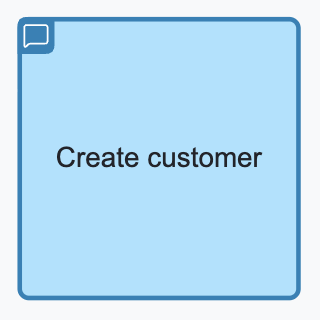
A command represents an intent for system state change / modification.
Query#
A query represents a request/response for data retrieval.
Event, External Event and Error#
Event#
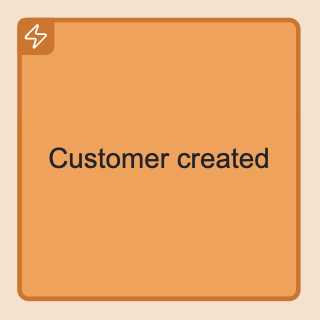
Events are produced by system components representing state changes. They can be used for Event Sourcing (if used in CQRS/ES architecture) or just be handled for event-based state transfer.
External Event#
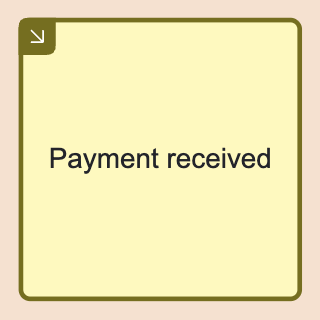
An event-based state transfer from external system can be implemented using External Event.
Error#
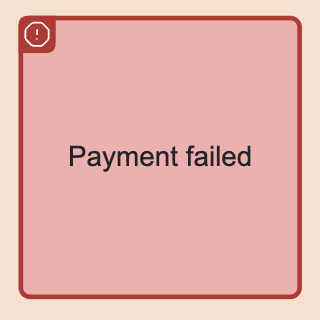
An error is a specific type of event, denoting the fact that the intended state change was rejected.
Information flow#
An information flow denotes a connection between two dynamic elements, meaning "causes". For example, a command dispatching causes a state change which is causing emitting of an event. In this case, a command is connected to an event.
Timeline#
A timeline is a visual representation of a particular journey consisting of triggers, messages and events connected together. A timeline has a temporal direction (time goes from left to right, all message flows should point from the past to the future). It might be separated into lanes, depending on the completeness and progress of the event modeling.
Lane#
There are three types of lanes:
Trigger Lane#
Trigger lane is a lane reserved for triggers. Multiple trigger lanes can be used to distinguish the role of the actor, using the trigger.
Interaction Lane#
Interaction lane: used to place interaction command: commands and queries.
Concept Lane#
Concept lane a lane holding the event messages, denoting the responsibility of command handling and state change.
Slice#
A slice is a user-made grouping of elements for different purposes. A slice can be named and represent a unit of implementation or a bounded piece of behaviour.
Specification#
A specification is a behaviour specification by example (often written in Given/When/Then form) including references to messages from the timeline or
slice, enriched with example values and specifying expected behaviour of the system.
Group / Annotation#
A group allows to group any amount of elements. Using a text annotation it is possible to attach comments to the groups or individual elements.